What is Blockchain Technology? A Step-by-Step Guide For Beginners
Is Blockchain Technology the New Internet?
The
blockchain is an undeniably ingenious invention – the brainchild of a
person or group of people known by the pseudonym, Satoshi Nakamoto. But
since then, it has evolved into something greater, and the main question
every single person is asking is: What is Blockchain?
By allowing
digital information to be distributed but not copied, blockchain
technology created the backbone of a new type of internet. Originally
devised for the
digital currency,
Bitcoin, (
Buy Bitcoin) the tech community has now found other potential uses for the technology.
In
thisguide, we are going to explain to you what the blockchain
technology is, and what its properties are that make it so unique. So,
we hope you enjoy this, What Is Blockchain Guide. And if you already
know what blockchain is and want to become a blockchain developer please
check out our in-depth
blockchain tutorial and create your very first blockchain.

Understanding Blockchain Technology
 “The
blockchain is an incorruptible digital ledger of economic transactions
that can be programmed to record not just financial transactions but
virtually everything of value.” – Don & Alex Tapscott, authors
Blockchain Revolution (2016).
“The
blockchain is an incorruptible digital ledger of economic transactions
that can be programmed to record not just financial transactions but
virtually everything of value.” – Don & Alex Tapscott, authors
Blockchain Revolution (2016).
A blockchain is, in the
simplest of terms, a time-stamped series of immutable record of data
that is managed by cluster of computers not owned by any single entity.
Each of these blocks of data (i.e. block) are secured and bound to each
other using cryptographic principles (i.e. chain).
So, what is so special about it and why are we saying that it has industry disrupting capabilities?
The
blockchain network has no central authority — it is the very definition
of a democratized system. Since it is a shared and immutable ledger,
the information in it is open for anyone and everyone to see. Hence,
anything that is built on the blockchain is by its very nature
transparent and everyone involved is accountable for their actions.
Blockchain Explained
A blockchain carries
no transaction cost.
(An infrastructure cost yes, but no transaction cost.) The blockchain
is a simple yet ingenious way of passing information from A to B in a
fully automated and safe manner. One party to a transaction initiates
the process by creating a block. This block is verified by thousands,
perhaps millions of computers distributed around the net. The verified
block is added to a chain, which is stored across the net, creating not
just a unique record, but a unique record with a unique history.
Falsifying a single record would mean falsifying the entire chain in
millions of instances. That is virtually impossible. Bitcoin uses this
model for monetary transactions, but it can be deployed in many others
ways.

Think of a railway company. We
buy tickets
on an app or the web. The credit card company takes a cut for
processing the transaction. With blockchain, not only can the railway
operator save on credit card processing fees, it can move the entire
ticketing process to the blockchain. The two parties in the transaction
are the railway company and the passenger. The ticket is a block, which
will be added to a ticket blockchain. Just as a monetary transaction on
blockchain is a unique, independently verifiable and unfalsifiable
record (like Bitcoin), so can your ticket be. Incidentally, the final
ticket blockchain is also a record of all transactions for, say, a
certain train route, or even the entire train network, comprising every
ticket ever sold, every journey ever taken.
But the key here is this: it’s free. Not only can the blockchain transfer and store money,
but it can also replace all processes and business models which rely on charging a small fee for a transaction. Or any other transaction between two parties.
Here
is another example. The gig economy hub Fivver charges 0.5 dollars on a
5 transaction between individuals buying and selling services. Using
blockchain technology the transaction is free. Ergo, Fivver will cease
to exist. So will auction houses and any other business entity based on
the market-maker principle.
Even recent entrants like
Uber and AirBnB
are threatened by blockchain technology. All you need to do is encode
the transactional information for a car ride or an overnight stay, and
again you have a perfectly safe way that disrupts the business model of
the companies which have just begun to challenge the traditional
economy. We are not just cutting out the fee-processing middle man, we
are also eliminating the need for the match-making platform.
Because blockchain
transactions are free,
you can charge minuscule amounts, say 1/100 of a cent for a video view
or article read. Why should I pay The Economist or National Geographic
an annual subscription fee if I can pay per article on Facebook or my
favorite chat app. Again, remember that blockchain transactions carry no
transaction cost. You can charge for anything in any amount without
worrying about third parties cutting into your profits.
Blockchain may make selling recorded
music
profitable again for artists by cutting out music companies and
distributors like Apple or Spotify. The music you buy could even be
encoded in the blockchain itself, making it a cloud archive for any song
purchased. Because the amounts charged can be so small, subscription
and streaming services will become irrelevant.
It goes further.
Ebooks could
be fitted with blockchain code. Instead of Amazon taking a cut, and the
credit card company earning money on the sale, the books would
circulate in encoded form and a successful blockchain transaction would
transfer money to the author and unlock the book. Transfer ALL the money
to the author, not just meager royalties. You could do this on a book
review website like Goodreads, or on your own website. The marketplace
Amazon is then unnecessary. Successful iterations could even include
reviews and other third-party information about the book.
In the
financial
world the applications are more obvious and the revolutionary changes
more imminent. Blockchains will change the way stock exchanges work,
loans are bundled, and insurances contracted. They will eliminate bank
accounts and practically all services offered by banks. Almost
every financial institution will go bankrupt
or be forced to change fundamentally, once the advantages of a safe
ledger without transaction fees is widely understood and implemented.
After all, the financial system is built on taking a small cut of your
money for the privilege of facilitating a transaction. Bankers will
become mere advisers, not gatekeepers of money. Stockbrokers will no
longer be able to earn commissions and the buy/sell spread will
disappear.
How Does Blockchain Work?
Picture
a spreadsheet that is duplicated thousands of times across a network of
computers. Then imagine that this network is designed to regularly
update this spreadsheet and you have a basic understanding of the
blockchain.
Information held on a blockchain exists as a shared —
and continually reconciled — database. This is a way of using the
network that has obvious benefits. The blockchain database isn’t stored
in any single location, meaning the records it keeps are truly public
and easily verifiable. No centralized version of this information exists
for a hacker to corrupt. Hosted by millions of computers
simultaneously, its data is accessible to anyone on the internet.
To go in deeper with the Google spreadsheet analogy, I would like you to read this piece from a blockchain specialist.
 “The
traditional way of sharing documents with collaboration is to send a
Microsoft Word document to another recipient, and ask them to make
revisions to it. The problem with that scenario is that you need to wait
until receiving a return copy before you can see or make other changes
because you are locked out of editing it until the other person is done
with it. That’s how databases work today. Two owners can’t be messing
with the same record at once.That’s how banks maintain money balances
and transfers; they briefly lock access (or decrease the balance) while
they make a transfer, then update the other side, then re-open access
(or update again).With Google Docs (or Google Sheets), both parties have
access to the same document at the same time, and the single version of
that document is always visible to both of them. It is like a shared
ledger, but it is a shared document. The distributed part comes into
play when sharing involves a number of people.
Imagine
the number of legal documents that should be used that way. Instead of
passing them to each other, losing track of versions, and not being in
sync with the other version, why can’t *all* business documents become
shared instead of transferred back and forth? So many types of legal
contracts would be ideal for that kind of workflow. You don’t need a
blockchain to share documents, but the shared documents analogy is a
powerful one.” – William Mougayar, Venture advisor, 4x entrepreneur,
marketer, strategist and blockchain specialist
“The
traditional way of sharing documents with collaboration is to send a
Microsoft Word document to another recipient, and ask them to make
revisions to it. The problem with that scenario is that you need to wait
until receiving a return copy before you can see or make other changes
because you are locked out of editing it until the other person is done
with it. That’s how databases work today. Two owners can’t be messing
with the same record at once.That’s how banks maintain money balances
and transfers; they briefly lock access (or decrease the balance) while
they make a transfer, then update the other side, then re-open access
(or update again).With Google Docs (or Google Sheets), both parties have
access to the same document at the same time, and the single version of
that document is always visible to both of them. It is like a shared
ledger, but it is a shared document. The distributed part comes into
play when sharing involves a number of people.
Imagine
the number of legal documents that should be used that way. Instead of
passing them to each other, losing track of versions, and not being in
sync with the other version, why can’t *all* business documents become
shared instead of transferred back and forth? So many types of legal
contracts would be ideal for that kind of workflow. You don’t need a
blockchain to share documents, but the shared documents analogy is a
powerful one.” – William Mougayar, Venture advisor, 4x entrepreneur,
marketer, strategist and blockchain specialist
The reason why the blockchain has gained so much admiration is that:
- It is not owned by a single entity, hence it is decentralized
- The data is cryptographically stored inside
- The blockchain is immutable, so no one can tamper with the data that is inside the blockchain
- The blockchain is transparent so one can track the data if they want to
The Three Pillars of Blockchain Technology
The three main properties of Blockchain Technology which has helped it gain widespread acclaim are as follows:
- Decentralization
- Transparency
- Immutability
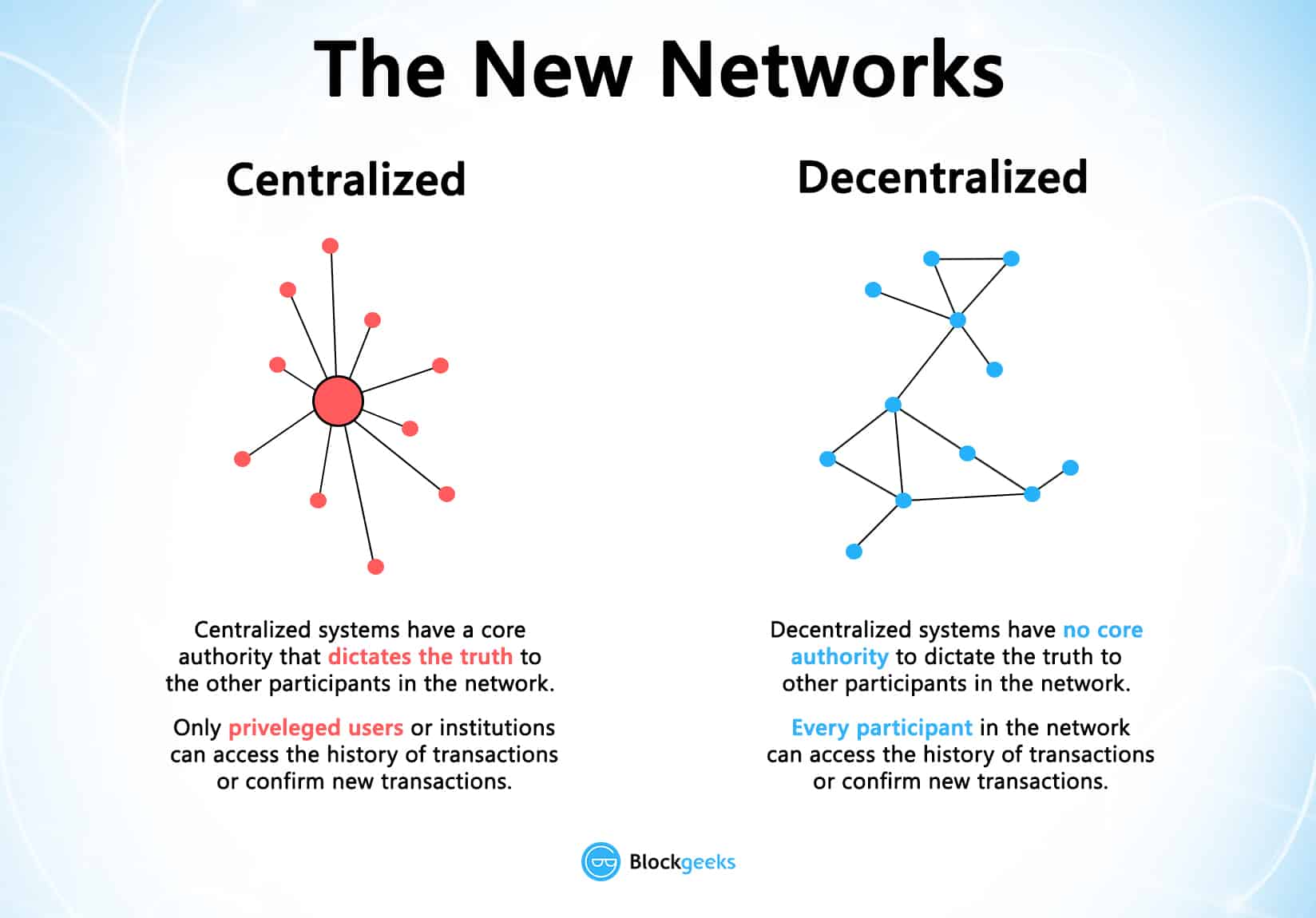
Pillar #1: Decentralization
Before
Bitcoin and BitTorrent came along, we were more used to centralized
services. The idea is very simple. You have a centralized entity which
stored all the data and you’d have to interact solely with this entity
to get whatever information you required.
Another example of a
centralized system is banks. They store all your money, and the only way
that you can pay someone is by going through the bank.
The traditional client-server model is a perfect example of this:
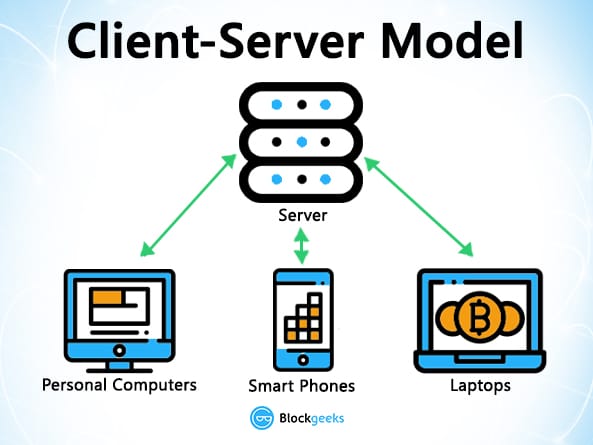
When
you google search for something, you send a query to the server who
then gets back at you with the relevant information. That is simple
client-server.
Now, centralized systems have treated us well for many years, however, they have several vulnerabilities.
- Firstly,
because they are centralized, all the data is stored in one spot. This
makes them easy target spots for potential hackers.
- If the centralized system were to go through a software upgrade, it would halt the entire system
- What
if the centralized entity somehow shut down for whatever reason? That
way nobody will be able to access the information that it possesses
- Worst
case scenario, what if this entity gets corrupted and malicious? If
that happens then all the data that is inside the blockchain will be
compromised.
So, what happens if we just take this centralized entity away?
In
a decentralized system, the information is not stored by one single
entity. In fact, everyone in the network owns the information.
In a
decentralized network, if you wanted to interact with your friend then
you can do so directly without going through a third party. That was the
main ideology behind Bitcoins. You and only you alone are in charge of
your money. You can send your money to anyone you want without having to
go through a bank.

Pillar #2: Transparency
One
of the most interesting and misunderstood concepts in blockchain
technology is “transparency.” Some people say that blockchain gives you
privacy while some say that it is transparent. Why do you think that
happens?
Well… a person’s identity is hidden via complex
cryptography and represented only by their public address. So, if you
were to look up a person’s transaction history, you will not see “Bob
sent 1 BTC” instead you will see “1MF1bhsFLkBzzz9vpFYEmvwT2TbyCt7NZJ
sent 1 BTC”.
The following snapshot of Ethereum transactions will show you what we mean:

So,
while the person’s real identity is secure, you will still see all the
transactions that were done by their public address. This level of
transparency has never existed before within a financial system. It adds
that extra, and much needed, level of accountability which is required
by some of these biggest institutions.
Speaking purely from the point of view of
cryptocurrency,
if you know the public address of one of these big companies, you can
simply pop it in an explorer and look at all the transactions that they
have engaged in. This forces them to be honest, something that they have
never had to deal with before.
However, that’s not the best
use-case. We are pretty sure that most of these companies won’t transact
using cryptocurrencies, and even if they do, they won’t do ALL their
transactions using cryptocurrencies. However, what if the blockchain
technology was integrated…say in their supply chain?
You can see why something like this can be very helpful for the finance industry right?
Pillar #3: Immutability
Immutability,
in the context of the blockchain, means that once something has been
entered into the blockchain, it cannot be tampered with.
Can you imagine how valuable this will be for financial institutes?
Imagine
how many embezzlement cases can be nipped in the bud if people know
that they can’t “work the books” and fiddle around with company
accounts.
The reason why the blockchain gets this property is that of cryptographic hash function.
In
simple terms, hashing means taking an input string of any length and
giving out an output of a fixed length. In the context of
cryptocurrencies like bitcoin, the transactions are taken as an input
and run through a hashing algorithm (bitcoin uses SHA-256) which gives
an output of a fixed length.
Let’s see how the hashing process
works. We are going to put in certain inputs. For this exercise, we are
going to use the SHA-256 (Secure Hashing Algorithm 256).

As
you can see, in the case of SHA-256, no matter how big or small your
input is, the output will always have a fixed 256-bits length. This
becomes critical when you are dealing with a huge amount of data and
transactions. So basically, instead of remembering the input data which
could be huge, you can just remember the hash and keep track.
A
cryptographic hash function is a special class of hash functions which
has various properties making it ideal for cryptography. There are
certain properties that a cryptographic hash function needs to have in
order to be considered secure. You can read about those in detail in our
guide on hashing.
There is just one property that we want you to focus on today. It is called the “Avalanche Effect.”
What does that mean?
Even
if you make a small change in your input, the changes that will be
reflected in the hash will be huge. Let’s test it out using SHA-256:

You
see that? Even though you just changed the case of the first alphabet
of the input, look at how much that has affected the output hash. Now,
let’s go back to our previous point when we were looking at blockchain
architecture. What we said was:
The blockchain is a linked list
which contains data and a hash pointer which points to its previous
block, hence creating the chain. What is a hash pointer? A hash pointer
is similar to a pointer, but instead of just containing the address of
the previous block it also contains the hash of the data inside the
previous block.
This one small tweak is what makes blockchains so amazingly reliable and trailblazing.
Imagine
this for a second, a hacker attacks block 3 and tries to change the
data. Because of the properties of hash functions, a slight change in
data will change the hash drastically. This means that any slight
changes made in block 3, will change the hash which is stored in block
2, now that in turn will change the data and the hash of block 2 which
will result in changes in block 1 and so on and so forth. This will
completely change the chain, which is impossible. This is exactly how
blockchains attain immutability.
Maintaining the Blockchain – Network and Nodes
The
blockchain is maintained by a peer-to-peer network. The network is a
collection of nodes which are interconnected to one another. Nodes are
individual computers which take in input and performs a function on them
and gives an output. The blockchain uses a special kind of network
called “peer-to-peer network” which partitions its entire workload
between participants, who are all equally privileged, called “peers”.
There is no longer one central server, now there are several distributed
and decentralized peers.
Why do people use the peer-to-peer network?
One
of the main uses of the peer-to-peer network is file sharing, also
called torrenting. If you are to use a client-server model for
downloading, then it is usually extremely slow and entirely dependent on
the health of the server. Plus, like we said, it is prone to
censorship.
However, in a peer-to-peer system, there is no central
authority, and hence if even one of the peers in the network goes out
of the race, you still have more peers to download from. Plus, it is not
subject to the idealistic standards of a central system, hence it is
not prone to censorship.
If we were to compare the two:

Image courtesy: Quora
The
decentralized nature of a peer-to-peer system becomes critical as we
move on to the next section. How critical? Well, the simple (at least on
paper) idea of combining this peer-to-peer network with a payment
system has completely revolutionized the finance industry by giving
birth to cryptocurrency.
The use of networks and nodes in cryptocurrencies.
The
peer-to-peer network structure in cryptocurrencies is structured
according to the consensus mechanism that they are utilizing. For
cryptos like Bitcoin and Ethereum which uses a normal proof-of-work
consensus mechanism (Ethereum will eventually move on to Proof of
Stake), all the nodes have the same privilege. The idea is to create an
egalitarian network. The nodes are not given any special privileges,
however, their functions and degree of participation may differ. There
is no centralized server/entity, nor is there any hierarchy. It is a
flat topology.
These decentralized cryptocurrencies are structured
like that is because of a simple reason, to stay true to their
philosophy. The idea is to have a currency system, where everyone is
treated as an equal and there is no governing body, which can determine
the value of the currency based on a whim. This is true for both bitcoin
and Ethereum.
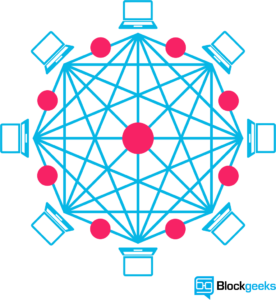
Now, if there is no central system, how would
everyone in the system get to know that a certain transaction has
happened? The network follows the gossip protocol. Think of how gossip
spreads. Suppose Alice sent 3 ETH to Bob. The nodes nearest to her will
get to know of this, and then they will tell the nodes closest to them,
and then they will tell their neighbors, and this will keep on spreading
out until everyone knows. Nodes are basically your nosy, annoying
relatives.
So, what is a node in the context of Ethereum? A node is simply a
computer that participates in the Ethereum network. This participation
can be in three ways
- By keeping a shallow-copy of the blockchain aka a Light Client
- By keeping a full-copy of the blockchain aka a Full Node
- By verifying the transactions aka Mining
However,
the problem with this design is that it is not really that scalable.
Which is why, a lot of new generation cryptocurrencies adopt a
leader-based consensus mechanism. In EOS, Cardano, Neo etc. the nodes
elect leader nodes or “super nodes” who are in charge of the consensus
and overall network health. These cryptos are a lot faster but they are
not the most decentralized of systems.
So, in a way, cryptos have to make the trade-off between speed and decentralization.
Who Will Use The Blockchain?
As web infrastructure, you don’t need to know about the blockchain for it to be useful in your life.
Currently,
finance offers the strongest use cases for the technology.
International remittances, for instance. The World Bank estimates that
over $430 billion US in money transfers were sent in 2015. And at the
moment there is a high demand for
blockchain developers.
The
blockchain potentially cuts out the middleman for these types of
transactions. Personal computing became accessible to the general public
with the invention of the Graphical User Interface (GUI), which took
the form of a “desktop”. Similarly, the most common GUI devised for the
blockchain are the so-called “wallet” applications, which people use to
buy things with Bitcoin, and store it along with other cryptocurrencies.
Transactions
online are closely connected to the processes of identity verification.
It is easy to imagine that wallet apps will transform in the coming
years to include other types of identity management.
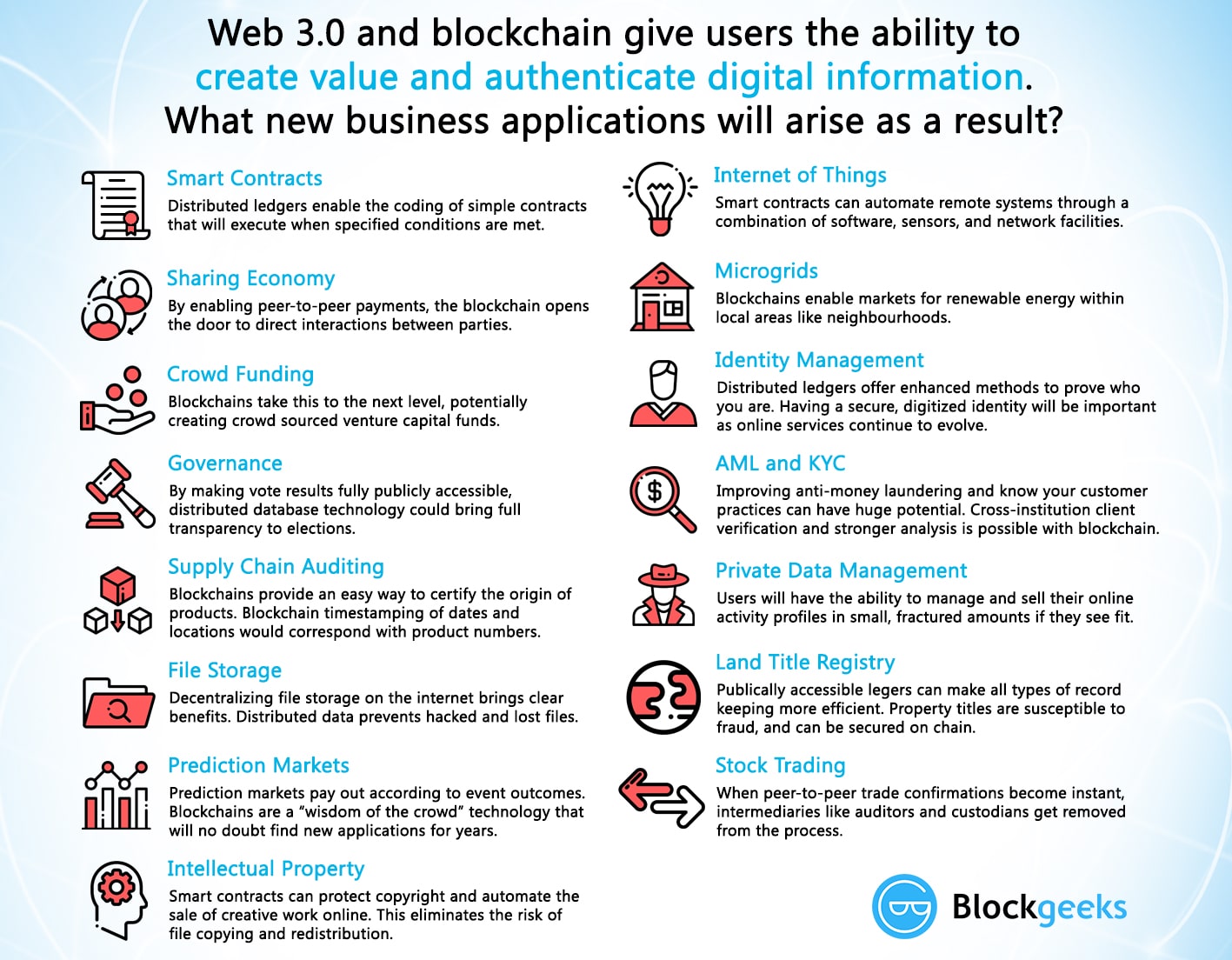
What is Blockchain? And What New Applications Will It Bring Us?
The blockchain gives internet users the ability to create value and authenticates digital information. What new business
applications will result from this?
#1 Smart contracts
Distributed
ledgers enable the coding of simple contracts that will execute when
specified conditions are met. Ethereum is an open source blockchain
project that was built specifically to realize this possibility. Still,
in its early stages, Ethereum has the potential to leverage the
usefulness of blockchains on a truly world-changing scale.
At the
technology’s current level of development, smart contracts can be
programmed to perform simple functions. For instance, a derivative could
be paid out when a financial instrument meets certain benchmark, with
the use of blockchain technology and Bitcoin enabling the payout to be
automated.
#2 The sharing economy
With
companies like Uber and Airbnb flourishing, the sharing economy is
already a proven success. Currently, however, users who want to hail a
ride-sharing service have to rely on an intermediary like Uber. By
enabling peer-to-peer payments, the blockchain opens the door to direct
interaction between parties — a truly decentralized sharing economy
results.
An early example, OpenBazaar uses the blockchain to
create a peer-to-peer eBay. Download the app onto your computing device,
and you can transact with OpenBazzar vendors without paying transaction
fees. The “no rules” ethos of the protocol means that personal
reputation will be even more important to business interactions than it
currently is on eBay.
#3 Crowdfunding
Crowdfunding
initiatives like Kickstarter and Gofundme are doing the advance work
for the emerging peer-to-peer economy. The popularity of these sites
suggests people want to have a direct say in product development.
Blockchains take this interest to the next level, potentially creating
crowd-sourced venture capital funds.
In 2016, one such experiment,
the Ethereum-based DAO (Decentralized Autonomous Organization), raised
an astonishing $200 million USD in just over two months. Participants
purchased “DAO tokens” allowing them to vote on smart contract venture
capital investments (voting power was proportionate to the number of DAO
they were holding). A subsequent hack of project funds proved that the
project was launched without proper due diligence, with disastrous
consequences. Regardless, the DAO experiment suggests the blockchain has
the potential to usher in “a new paradigm of economic cooperation.”
#4 Governance
By
making the results fully transparent and publicly accessible,
distributed database technology could bring full transparency to
elections or any other kind of poll taking. Ethereum-based smart
contracts help to automate the process.
The app, Boardroom,
enables organizational decision-making to happen on the blockchain. In
practice, this means company governance becomes fully transparent and
verifiable when managing digital assets, equity or information.
#5 Supply chain auditing
Consumers
increasingly want to know that the ethical claims companies make about
their products are real. Distributed ledgers provide an easy way to
certify that the backstories of the things we buy are genuine.
Transparency comes with blockchain-based timestamping of a date and
location — on ethical diamonds, for instance — that corresponds to a
product number.
The UK-based Provenance offers supply chain
auditing for a range of consumer goods. Making use of the Ethereum
blockchain, a Provenance pilot project ensures that fish sold in Sushi
restaurants in Japan has been sustainably harvested by its suppliers in
Indonesia.
#6 File storage
Decentralizing
file storage on the internet brings clear benefits. Distributing data
throughout the network protects files from getting hacked or lost.
Inter
Planetary File System (IPFS) makes it easy to conceptualize how a
distributed web might operate. Similar to the way a BitTorrent moves
data around the internet, IPFS gets rid of the need for centralized
client-server relationships (i.e., the current web). An internet made up
of completely decentralized websites has the potential to speed up file
transfer and streaming times. Such an improvement is not only
convenient. It’s a necessary upgrade to the web’s currently overloaded
content-delivery systems.
#7 Prediction markets
The
crowdsourcing of predictions on event probability is proven to have a
high degree of accuracy. Averaging opinions cancels out the unexamined
biases that distort judgment. Prediction markets that payout according
to event outcomes are already active. Blockchains are a “wisdom of the
crowd” technology that will no doubt find other applications in the
years to come.
The prediction market application Augur makes share
offerings on the outcome of real-world events. Participants can earn
money by buying into the correct prediction. The more shares purchased
in the correct outcome, the higher the payout will be. With a small
commitment of funds (less than a dollar), anyone can ask a question,
create a market based on a predicted outcome, and collect half of all
transaction fees the market generates.
#8 Protection of intellectual property
As
is well known, digital information can be infinitely reproduced — and
distributed widely thanks to the internet. This has given web users
globally a goldmine of free content. However, copyright holders have not
been so lucky, losing control over their intellectual property and
suffering financially as a consequence. Smart contracts can protect
copyright and automate the sale of creative works online, eliminating
the risk of file copying and redistribution.
Mycelia uses the
blockchain to create a peer-to-peer music distribution system. Founded
by the UK singer-songwriter Imogen Heap, Mycelia enables musicians to
sell songs directly to audiences, as well as license samples to
producers and divvy up royalties to songwriters and musicians — all of
these functions being automated by smart contracts. The capacity of
blockchains to issue payments in fractional cryptocurrency amounts
(micropayments) suggests this use case for the blockchain has a strong
chance of success.
#9 Internet of Things (IoT)
What
is the IoT? The network-controlled management of certain types of
electronic devices — for instance, the monitoring of air temperature in a
storage facility. Smart contracts make the automation of remote systems
management possible. A combination of software, sensors, and the
network facilitates an exchange of data between objects and mechanisms.
The result increases system efficiency and improves cost monitoring.
The
biggest players in manufacturing, tech and telecommunications are all
vying for IoT dominance. Think Samsung, IBM and AT&T. A natural
extension of existing infrastructure controlled by incumbents, IoT
applications will run the gamut from predictive maintenance of
mechanical parts to data analytics, and mass-scale automated systems
management.
#10 Neighbourhood Microgrids
Blockchain
technology enables the buying and selling of the renewable energy
generated by neighborhood microgrids. When solar panels make excess
energy, Ethereum-based smart contracts automatically redistribute it.
Similar types of smart contract automation will have many other
applications as the IoT becomes a reality.
Located in Brooklyn,
Consensys is one of the foremost companies globally that is developing a
range of applications for Ethereum. One project they are partnering on
is Transactive Grid, working with the distributed energy outfit, LO3. A
prototype project currently up and running uses Ethereum smart contracts
to automate the monitoring and redistribution of microgrid energy. This
so-called “intelligent grid” is an early example of IoT functionality.
#11 Identity management
There
is a definite need for better identity management on the web. The
ability to verify your identity is the lynchpin of financial
transactions that happen online. However, remedies for the security
risks that come with web commerce are imperfect at best. Distributed
ledgers offer enhanced methods for proving who you are, along with the
possibility to digitize personal documents. Having a secure identity
will also be important for online interactions — for instance, in the
sharing economy. A good reputation, after all, is the most important
condition for conducting transactions online.
Developing digital
identity standards is proving to be a highly complex process. Technical
challenges aside, a universal online identity solution requires
cooperation between private entities and government. Add to that the
need to navigate legal systems in different countries and the problem
becomes exponentially difficult. E-Commerce on the internet currently
relies on the SSL certificate (the little green lock) for secure
transactions on the web. Netki is a startup that aspires to create an
SSL standard for the blockchain. Having recently announced a $3.5
million seed round, Netki expects a product launch in early 2017.
#12 AML and KYC
Anti-money
laundering (AML) and know your customer (KYC) practices have a strong
potential for being adapted to the blockchain. Currently, financial
institutions must perform a labour intensive multi-step process for each
new customer. KYC costs could be reduced through cross-institution
client verification, and at the same time increase monitoring and
analysis effectiveness.
Startup Polycoin has an AML/KYC solution
that involves analysing transactions. Those transactions identified as
being suspicious are forwarded on to compliance officers. Another
startup Tradle is developing an application called Trust in Motion
(TiM). Characterized as an “Instagram for KYC”, TiM allows customers to
take a snapshot of key documents (passport, utility bill, etc.). Once
verified by the bank, this data is cryptographically stored on the
blockchain.
#13 Data management
Today, in
exchange for their personal data people can use social media platforms
like Facebook for free. In future, users will have the ability to manage
and sell the data their online activity generates. Because it can be
easily distributed in small fractional amounts, Bitcoin — or something
like it — will most likely be the currency that gets used for this type
of transaction.
The MIT project Enigma understands that user
privacy is the key precondition for creating of a personal data
marketplace. Enigma uses cryptographic techniques to allow individual
data sets to be split between nodes, and at the same time run bulk
computations over the data group as a whole. Fragmenting the data also
makes Enigma scalable (unlike those blockchain solutions where data gets
replicated on every node). A Beta launch is promised within the next
six months.
#14 Land title registration
As
Publicly-accessible ledgers, blockchains can make all kinds of
record-keeping more efficient. Property titles are a case in point. They
tend to be susceptible to fraud, as well as costly and labour intensive
to administer.
A number of countries are undertaking
blockchain-based land registry projects. Honduras was the first
government to announce such an initiative in 2015, although the current
status of that project is unclear. This year, the Republic of Georgia
cemented a deal with the Bitfury Group to develop a blockchain system
for property titles. Reportedly, Hernando de Soto, the high-profile
economist and property rights advocate, will be advising on the project.
Most recently, Sweden announced it was experimenting with a blockchain
application for property titles.
#15 Stock trading
The
potential for added efficiency in share settlement makes a strong use
case for blockchains in stock trading. When executed peer-to-peer, trade
confirmations become almost instantaneous (as opposed to taking three
days for clearance). Potentially, this means intermediaries — such as
the clearing house, auditors and custodians — get removed from the
process.
Numerous stock and commodities exchanges are prototyping
blockchain applications for the services they offer, including the ASX
(Australian Securities Exchange), the Deutsche Börse (Frankfurt’s stock
exchange) and the JPX (Japan Exchange Group). Most high profile because
the acknowledged first mover in the area, is the Nasdaq’s Linq, a
platform for private market trading (typically between pre-IPO startups
and investors). A partnership with the blockchain tech company Chain,
Linq announced the completion of it its first share trade in 2015. More
recently, Nasdaq announced the development of a trial blockchain project
for proxy voting on the Estonian Stock Market.

“
As
revolutionary as it sounds, Blockchain truly is a mechanism to bring
everyone to the highest degree of accountability. No more missed
transactions, human or machine errors, or even an exchange that was not
done with the consent of the parties involved. Above anything else, the
most critical area where Blockchain helps is to guarantee the validity
of a transaction by recording it not only on a main register but a
connected distributed system of registers, all of which are connected
through a secure validation mechanism.” –
Ian Khan, TEDx Speaker | Author | Technology Futurist